( National Innovation Foundation - India )
Conversion of Circular Motion to Reciprocating Motion & Vice Versa
By : Mr. Joshua Devanathan P.,
Chennai,
Tamil Nadu
Innovation Description
Profile
Innovator Mr. Joshua hails from Chennai district of Tamil Nadu. He is a Christian Pastor. Though he is not an engineer by profession but he has a strong blend of mind towards mechanics.
Purpose
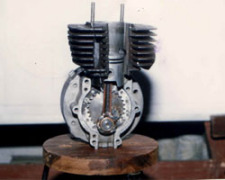
For many years research engineers in the field of Mechanical Engineering have been trying to find an alternative for the SLIDER CRANK mechanism. It is only the conversions of reciprocating motion in to circular motion and vice versa. This innovation replaces the slider crank mechanism, which works on the principle of hypocycloid.
Technical details
The power-transmitting end of the connecting rod does not move in a circular motion. But travels vertically up and down or horizontally back and forth side ways. This mechanism consists of a set of internal gears; one spur gear, which revolves within a directing gear whose teeth are cut internally, which, is fixed firmly to the casing. One end of connecting rod is fixed to a crank pin; so as to enable the pin to revolve freely and in turn is fixed firmly overlapping the small gear (spur gear) at eccentrics. The small gear is firmly fixed to a shaft that freely revolves in a circular disc, which is attached to the main shaft. When the connecting rod moves up & down vertically, the crank pin also moves in the same direction, without any side ways movement as in the slider crank mechanism and the spur gear revolves freely within the directing gear driving the disc in a circular motion.
Performance
The power-transmitting end of the connecting rod does not move in a circular motion. But travels vertically up and down or horizontally back and forth side ways. The loss of power due to side thrust caused by slider crank mechanism is reduced, resulting in increased efficiency.
Benefits
It can be applied in lathes, pumps, saws, etc.
Suggested Reading(s):
Christian, L. M. (1957). Mechanism for converting rotary motion to or from reciprocating motion. U.S. Patent No. 2,782,646. Washington, DC: U.S. Patent and Trademark Office.
Johnson, A. (2005). Linear into rotatory or vice versa motion convertor. U.S. Patent Application No. 10/519,957.
For More Details Please Contact on enquiry[at]nifindia[dot]org